

AI Didn’t Kill ROI. It Killed the Excuse.
Companies were already drowning in features, documents, dashboards, and roadmaps nobody could tie to value. AI just made the overproduction faster, cheaper, and impossible for CFOs to ignore.

Every time a CFO asks where the ROI from AI is, I think we are answering the wrong version of the question.
The usual answer is that AI is not delivering enough value yet. That companies are spending money on tools, licenses, pilots, infrastructure, training, and consultants, but the financial return is not obvious. And honestly, that concern is fair. AI is becoming a real cost line. At some point, the story has to survive a spreadsheet.
But I think the uncomfortable part is deeper.
The problem is not only that AI ROI is hard to prove.
The problem is that product ROI was already hard to prove.
Most companies ship constantly. New features, integrations, dashboards, settings, onboarding changes, internal tools, compliance work, migrations, experiments, sales requests, customer-specific asks. Every week, the product changes. The roadmap moves. The release notes grow. The dashboards show activity. Then the business keeps growing, and we tell ourselves a convenient story: the product development machine created that growth.
Sometimes it did.
But often, I think we are much less sure than we pretend.
A company can grow because the product is better. But it can also grow because the category is expanding, the sales team has strong relationships, customers have switching costs, procurement already approved the vendor, the brand feels safe, customer success protected renewals, pricing changed, a competitor stumbled, or the company has simply accumulated enough inertia that growth continues even when nobody can point to the exact product change that caused it.
This does not mean product work has no value. It means the value signal is delayed, distributed, and messy.
And AI is making that impossible to ignore.
We Already Create More Than We Need
My suspicion is that many companies already create more product development work than they need.
Not because people are lazy. Usually the opposite. People are working very hard. They are responding to customers, sales pressure, executive ideas, competitor comparisons, roadmap commitments, compliance requirements, internal escalations, platform needs, and the permanent pressure to show progress.
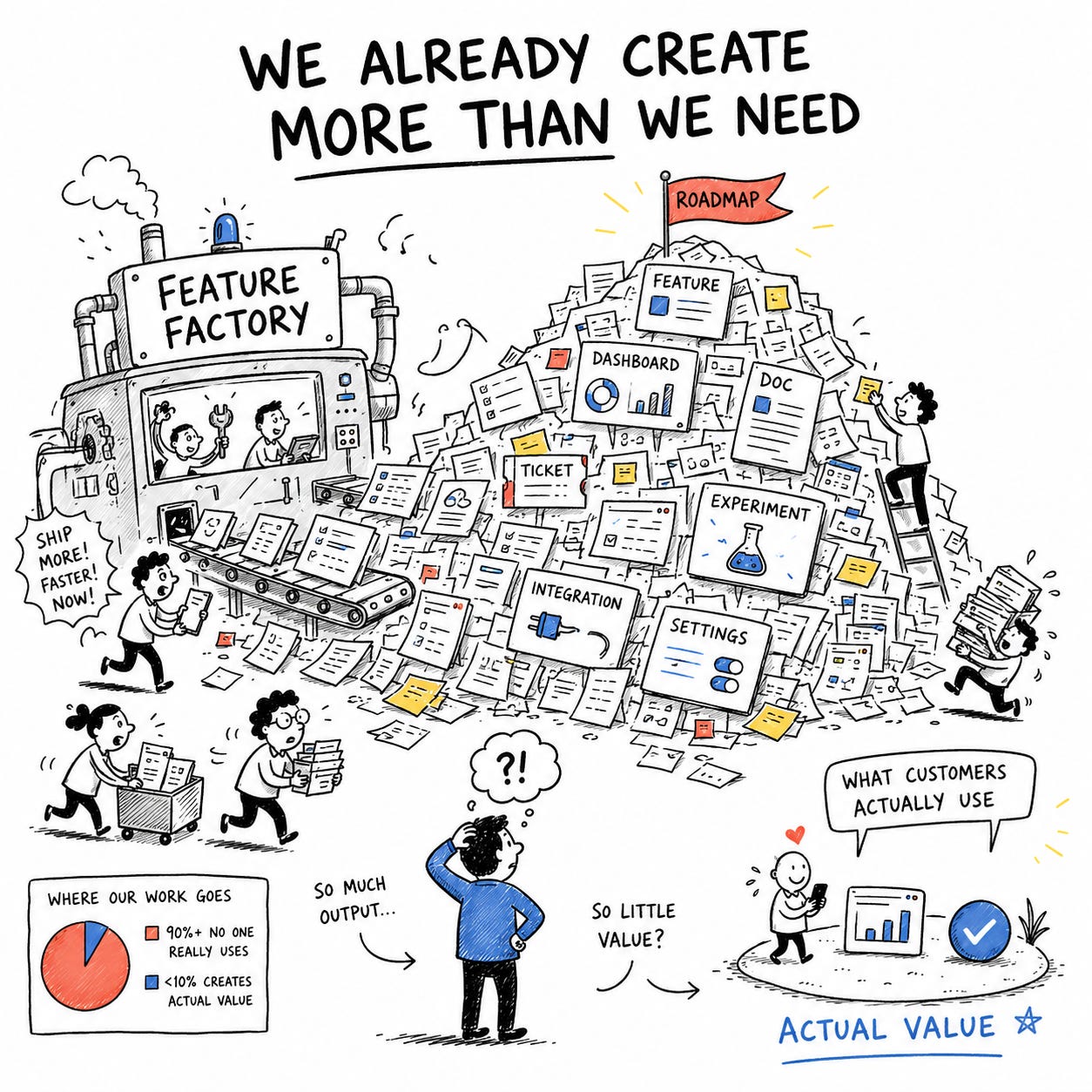
But the system is biased toward creation.
It is easier to add than to remove. Easier to build than to say no. Easier to ship the small request than to challenge whether it should exist. Easier to satisfy the stakeholder than to explain why their idea is not strategically important. Easier to show a roadmap full of activity than a roadmap full of hard decisions.
Over time, the product becomes a museum of accumulated commitments.
Some of those commitments create value. Some protect value. Some reduce friction. Some help sales. Some are necessary but invisible. But many exist because, at some point, they were plausible, urgent, political, requested, or cheap enough to build.
This is why feature adoption benchmarks are so uncomfortable. Pendo’s research found that only a small percentage of features drive most usage. The exact number will not map perfectly to every product, but the pattern is familiar to anyone who has spent enough time inside a mature product. A small part of the product carries most of the usage. A long tail exists because someone once asked for it, someone once sold it, someone once feared removing it, or someone once needed the roadmap to look alive.
That was already true before AI.
Now imagine making the feature factory faster.
Without changing the decision system.
Growth Is Not a Clean Product Signal
This is the part I think CFOs and product organizations both get wrong in different ways.
CFOs may look at growth and assume it is connected to product development output. Product and engineering teams may look at growth and assume the same thing, because it validates the work. The business grew, therefore the roadmap mattered. Revenue expanded, therefore the features were worth it. Customers renewed, therefore the product investments were right.
But growth is not that clean.
Especially in B2B, revenue is a delayed signal. Buyers do not move in a straight line from feature to purchase. They build consensus. They revisit problems. They compare vendors. They wait for budget. They negotiate risk. They seek internal validation. They may buy because the product improved, but they may also buy because the organization already trusts the vendor, the implementation team is strong, the champion has political capital, or the cost of switching is too high.
The same is true for existing customers. Renewals and expansions often come from accumulated trust, customer success work, procurement inertia, switching costs, usage habits, implementation depth, and relationship capital. Product matters, but not always in the linear way our roadmaps imply.
So when the business grows, the product development machine avoids scrutiny.
We assume the machine is working because the company is moving.
But maybe the company is moving because of inertia, not because every new output created value.
That is the painful distinction.
The company may be growing with the product, but not because of all the product work.
Some work creates value. Some protects value. Some is invisible but necessary. Some is waste. Some is pure feature-factory exhaust.
And because the company is still growing, nobody is forced to ask which is which.
AI Makes the Old Problem Impossible to Ignore
AI changes this because it removes one of the last constraints: the cost of producing things.
Before AI, effort acted as a filter. A feature required engineering time. A document required attention. A prototype required someone to build it. A test suite required effort. A support article required writing. A sales asset required time. This did not make the system good at prioritization, but at least production was expensive enough to create some friction.
AI weakens that friction.
Now every weak idea can have a spec. Every spec can have a prototype. Every prototype can generate code. Every code change can generate tests. Every meeting can generate a summary. Every summary can generate follow-up tasks. Every customer request can generate a polished justification. Every internal opinion can become a strategy document.
The company starts producing more because it can.
And this is where AI ROI gets confusing.
AI may reduce the local cost of production. It may help a person write faster, summarize faster, code faster, analyze faster, respond faster. There is evidence of productivity gains in bounded contexts. But local acceleration is not the same as system value.
If AI helps engineering write more code, someone still has to review it. If it helps product generate more ideas, someone still has to kill most of them. If it helps support answer faster, someone still has to detect the product pattern underneath. If it helps leadership generate more analysis, someone still has to make a decision. If it helps every department create more artifacts, the organization still has to validate, prioritize, maintain, explain, sell, support, and own those artifacts.
That is the trap.
AI can make output cheaper while making the company heavier.
Because cheap to create is not cheap to own.
Every feature still has a carrying cost: documentation, QA, security, support, maintenance, cognitive load, sales enablement, customer confusion, product surface area, and strategic distraction. AI can reduce creation cost, but it does not remove ownership cost.
This is where slop enters the company.
Not only as ugly AI content. As unnecessary work that looks professional enough to survive. A polished product brief with no real trade-off. A roadmap analysis with no decision. A generated PR that creates review burden. A strategy document that sounds smart but changes nothing. A customer summary that is fluent but misses the actual pain.
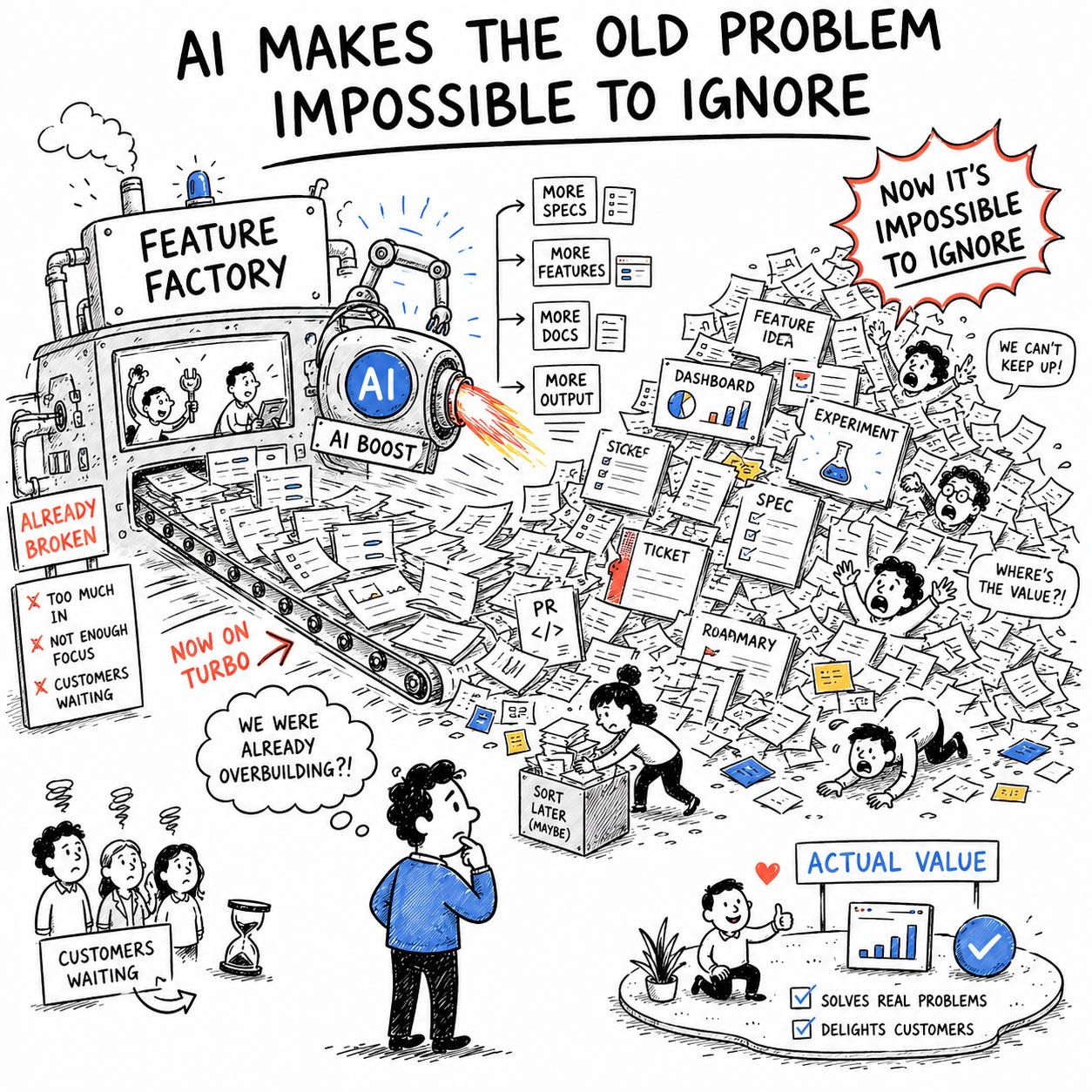
AI did not create the old bias toward output.
It made it faster, cheaper, and harder to excuse.
Our Departments Are Already Oversized
This is the uncomfortable conclusion.
Many departments are already too big for the amount of value they can actually validate.
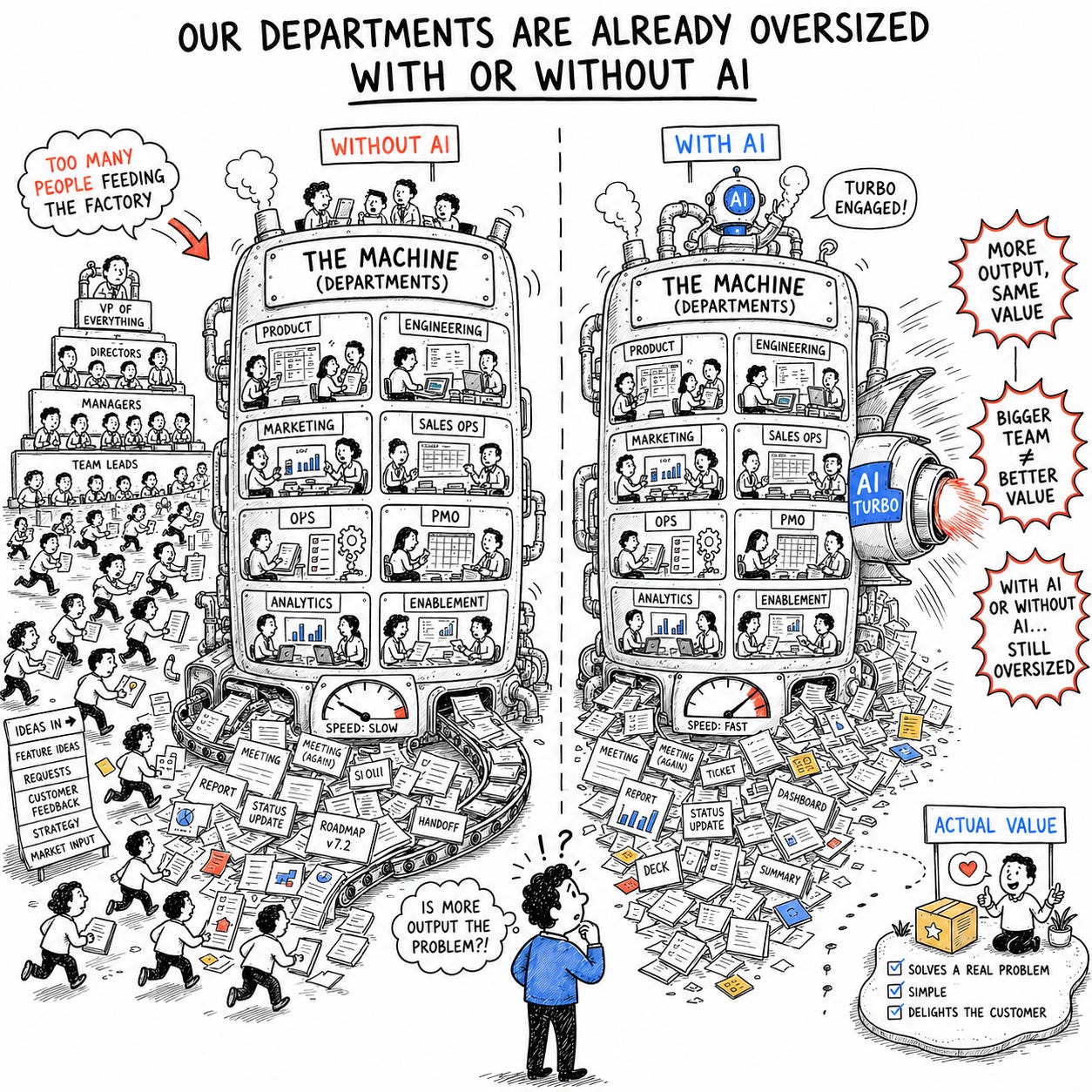
Not too big because people are lazy. Too big because they were designed for an older world where producing work was expensive. More people meant more features, more documents, more tickets, more campaigns, more analysis, more delivery.
AI breaks that logic.
If output becomes cheap, output is no longer the scarce thing.
Validation is.
The real question is not whether AI can help us generate more. Of course it can. That is the least interesting part.
The real question is whether we can finally admit that we were already generating too much.
AI makes the waste impossible to hide.
The companies that win with AI will not be the ones that produce the most. They will be the ones that need less production because they validate value better.
Smaller departments.
Sharper decisions.
Fewer features.
Less theater.
More value.
That is the ROI.