


Execution is no longer scarce. It has been compressed by years of tooling improvements and, more recently, by AI. The cost of producing software continues to fall.
What has not changed is everything around it.
Decisions are still slow.
Validation is still uncertain.
Alignment is still expensive.
This creates a structural imbalance: the system can now produce more than it can meaningfully process.
At that point, improving speed stops being useful and just hinders the system.
What matters is how the system decides what deserves to be scaled.
1. Optimize for Learning Velocity, not Delivery Speed
Speed only creates value if it is connected to learning. Shipping faster does not matter if the system cannot determine whether what was shipped was correct. The real loop is not:
build → ship → repeat
It is:
decide → build → learn → adjust
And in many organizations, the “learn” step is the weakest.
Feedback is delayed, indirect, or disconnected from the original decision. By the time signals arrive, multiple layers of work have already been built on top of unvalidated assumptions. The system moves quickly, but without a tight connection to reality.
Improving this does not require more data, but better alignment between decisions and feedback.
Every initiative should define, upfront, what change it expects to create—whether in user behavior, system performance, or business outcomes. Feedback mechanisms should be designed to observe that change as directly as possible. When that is not feasible, uncertainty should be made explicit rather than ignored.
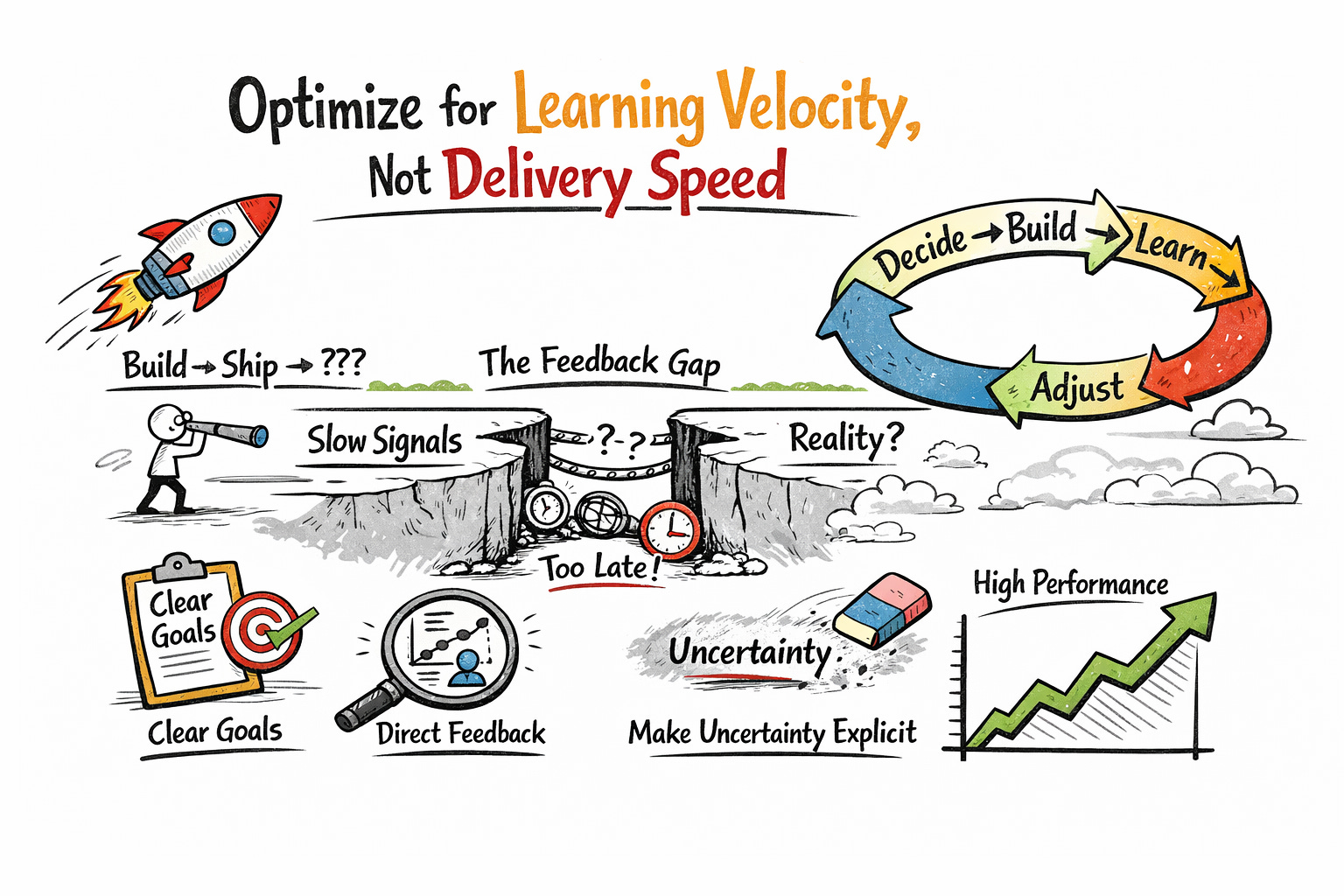
Research on software delivery performance consistently shows that high-performing teams are defined not just by speed, but by how quickly they can detect and recover from mistakes.
In a world of cheap execution, the advantage is not who builds faster.
It is who learns faster.
2. Design for Flow Efficiency, not Resource Efficiency
Most organizations are still optimized for keeping people busy. Maximizing utilization. Filling roadmaps. Ensuring constant activity.
This made sense when execution was expensive—when writing, testing, and shipping software required significant effort and time. But that constraint is fading. AI has reduced the cost of execution dramatically.
What hasn’t changed is how organizations are designed. Activity is no longer scarce. Attention is.
And yet, many teams continue to optimize for utilization, as if idle time were the primary risk. It isn’t. The real problem is not idle engineers—it is work that doesn’t move.
Work that sits in queues. Waiting for decisions. Waiting for alignment. Waiting for context. Waiting to be understood. This is where most time is lost.
Flow efficiency shifts the lens. Instead of asking whether people are busy, it asks whether work is progressing smoothly through the system. Whether ideas become outcomes without unnecessary friction.
This leads to very different design choices.
Smaller batches, so uncertainty and decisions surface earlier instead of accumulating. Fewer parallel initiatives, so attention is not fragmented across competing priorities. Reduced handoffs, so context is preserved and rework minimized. Clear ownership, so work does not stall in ambiguity or shared responsibility.
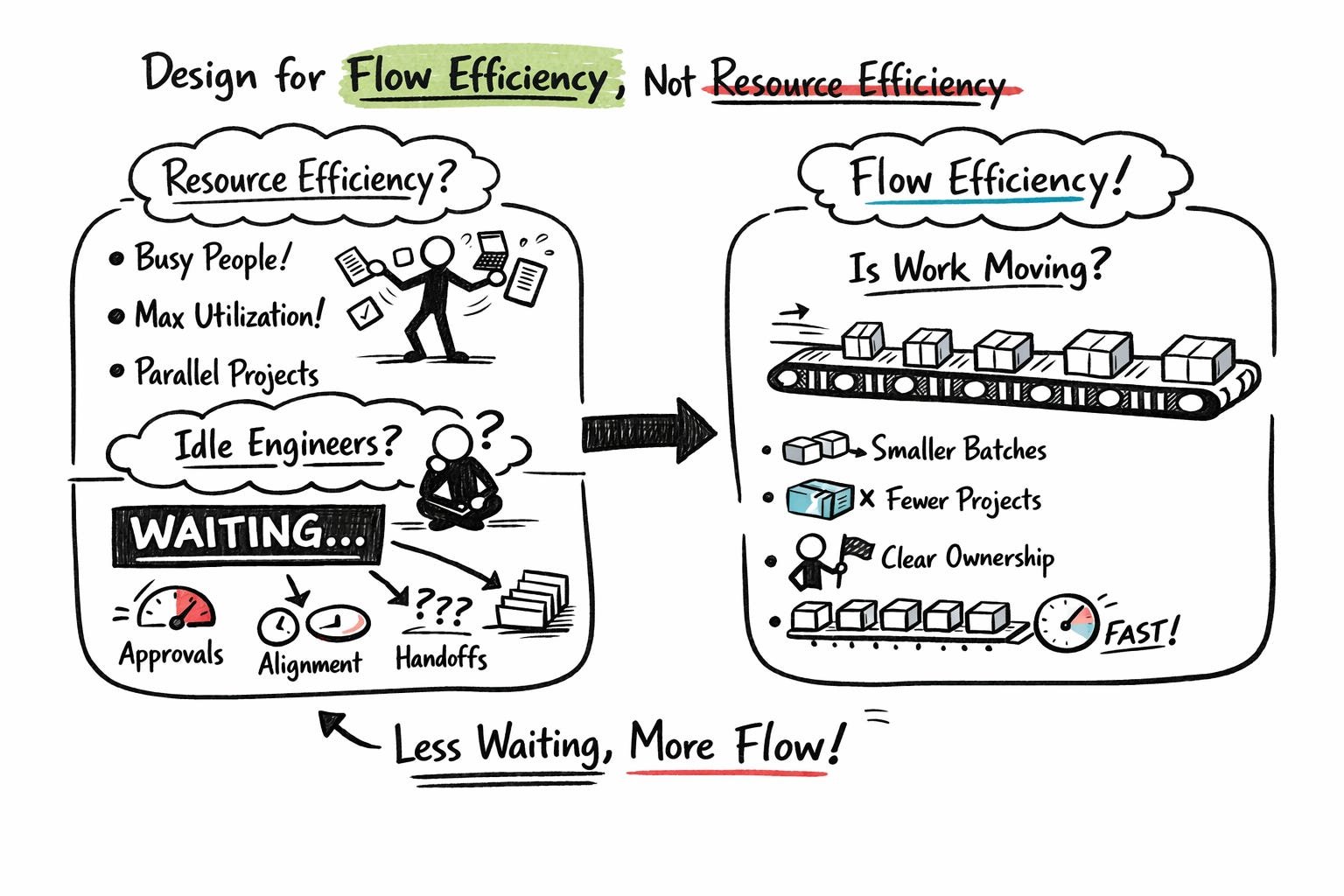
These are not optimizations of effort—they are optimizations of movement.
Research in lean systems and software delivery consistently shows that reducing work-in-progress and shortening queues improves system performance disproportionately. Not by increasing output, but by eliminating waiting time and coordination overhead.
Because when execution becomes fast, queues become the dominant constraint.
And most organizations are full of invisible ones.
3. Institutionalize the Ability to Say No
When execution becomes cheap, the default response is to build more. More features, more initiatives, more surface area. Work enters the system easily, almost automatically, because the cost of saying “yes” has collapsed.
But the cost of carrying what you build has not.
Every addition introduces complexity. Dependencies increase, constraints accumulate, and the system becomes harder to evolve. These costs are not immediate, which is why they are often ignored. Over time, the system doesn’t fail because it lacks capability—it fails because it has too much of it.
At that point, speed stops helping. You can still ship, but each change requires more coordination, more context, more effort. The system moves, but with increasing friction.
This is rarely framed as a consequence of saying “yes” too often, but that is exactly what it is.
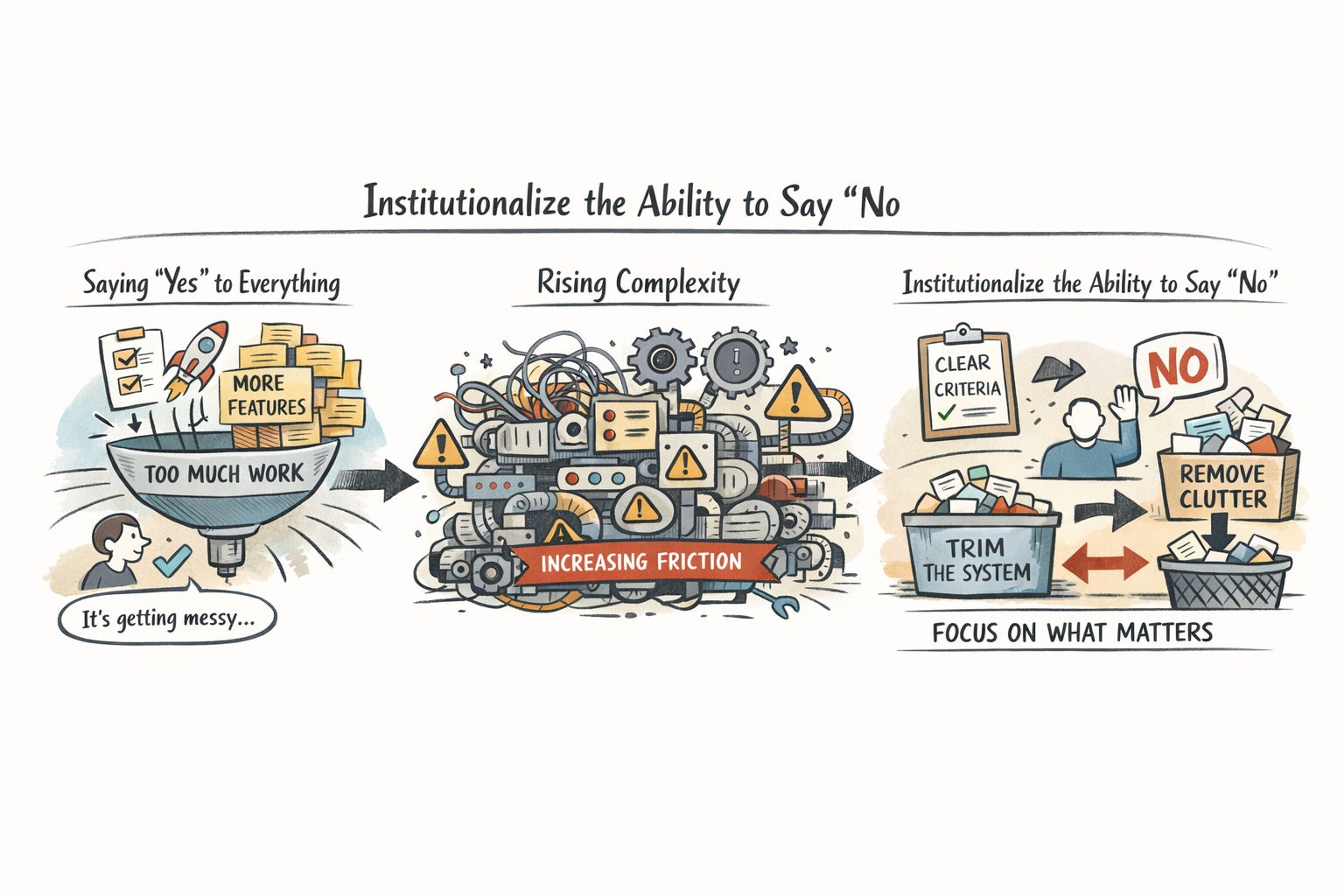
In most organizations, saying no is informal. It depends on individuals, moments, and negotiation. That makes it inconsistent. Some things are rejected, many are not, and very little is ever removed.
Without removal, complexity only grows.
Research on cognitive load consistently shows that beyond a certain point, more options and features degrade both usability and decision quality. More is not neutral. It actively makes the system worse.
In a world where building is cheap, the constraint is no longer creation.
It is how much you allow into the system—and how much you are willing to remove.
Conclusion
Execution now scales easily. That is no longer where advantage comes from.
What defines the system is how quickly it learns, how smoothly work flows, and how much unnecessary complexity it avoids. These are not improvements on top of the system—they are what the system is now built around.
Organizations that continue to optimize for output will produce more.
Organizations that adapt will produce less—but with far greater clarity and impact.
Because once building becomes cheap, the real discipline is not in what you create. It is in what you choose not to carry forward.