

The Hardest Part of AI Is Letting Go of Our Ego
We were trained to be right. In a world where machines generate faster than we can think, the real challenge is learning to judge instead.

There has always been a quiet tax in engineering organizations. Not in infrastructure. Not in tooling. Not even in process.
A human tax.
Ego.
For years, we tolerated it because it often looked useful. It looked like judgment. It looked like the healthy skepticism of people who had seen systems fail, architectures collapse, and teams burn under bad decisions. And sometimes it was exactly that.
But ego in engineering has always had a way of disguising itself as wisdom. It shows up when ideas are rejected too quickly, when unfamiliar approaches are treated as inferior by default, and when being right becomes more important than finding what is right.
That problem is not new.
What is new is that AI is making it impossible to ignore.
Because for the first time, we are not just dealing with junior engineers, new frameworks, or different opinions. We are dealing with systems that can generate viable solutions faster than we can reason through them. That changes the cost of ego completely.
The hardest part of AI is not the technology.
It is what it exposes in us.
Experience Was Always a Double-Edged Sword
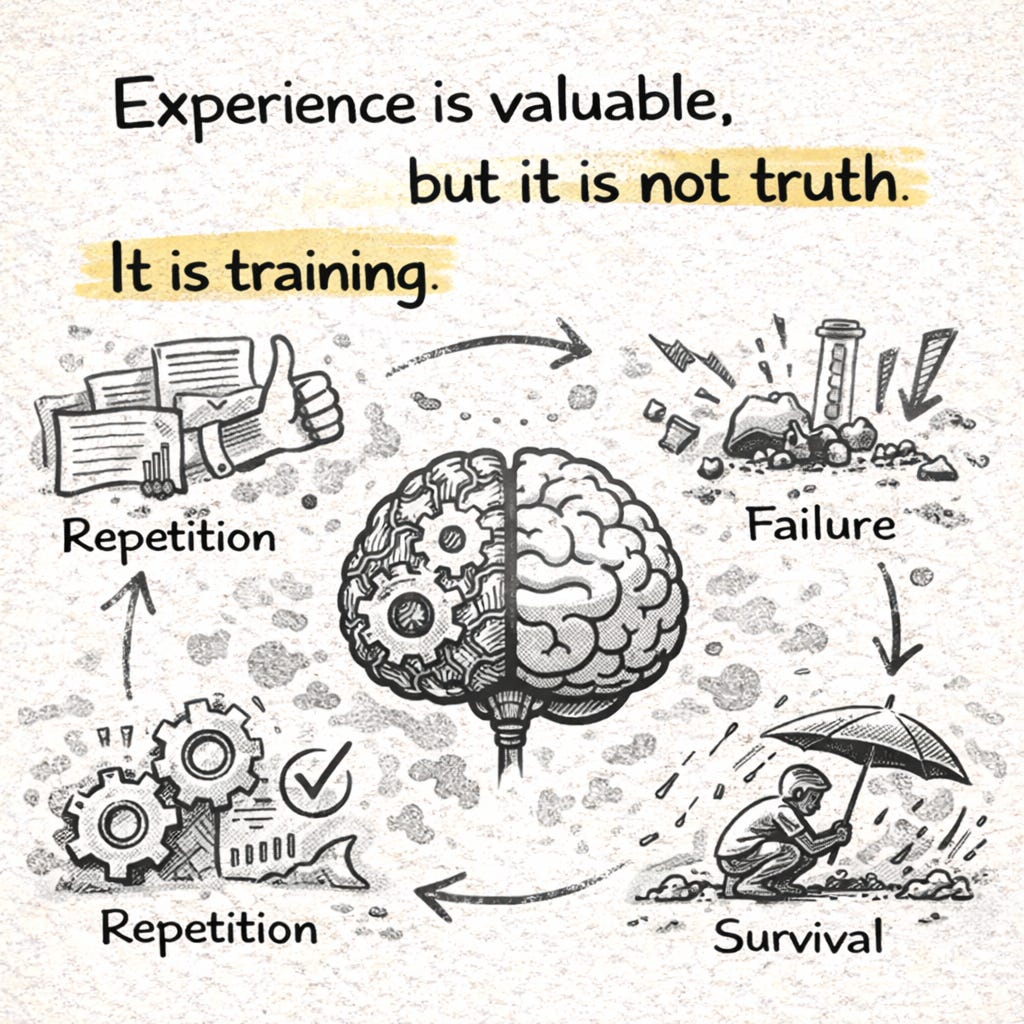
Experience is valuable, but it is not truth.
It is training.
What we call experience is really just a brain shaped by repetition, feedback, failure, and survival. We do not solve most engineering problems from first principles every time. We recognize patterns. We follow familiar paths. We reuse what has worked before. That is what makes experienced engineers effective in the first place.
But the same mechanism that makes us effective also makes us rigid.
A brain trained on years of similar constraints becomes efficient by exploring less. It learns what usually works, what usually fails, and what is usually not worth trying. That creates speed. It also creates bias. We become better at navigating the world that trained us, but worse at noticing when the world itself has changed.
This is where ego enters the system.
Because once experience hardens, we stop treating our mental models as useful approximations and start treating them as authority. We grow attached to legibility, familiarity, and control. We trust what we can explain. We distrust what does not fit our internal map. That is why ego in engineering so often looks like rigor. It is often just our need for control disguised as judgment.
That is why experience is always a double-edged sword. It gives us judgment, but it also narrows the range of things we are willing to take seriously. It sharpens intuition, but it can also turn intuition into an unchallenged default.
For a long time, that trade-off was acceptable. Engineering was mostly deterministic. The more experience we had, the more our mental models aligned with reality. Familiarity was a reasonable proxy for correctness.
That is the assumption AI starts to break.
The Moment the Rules Changed
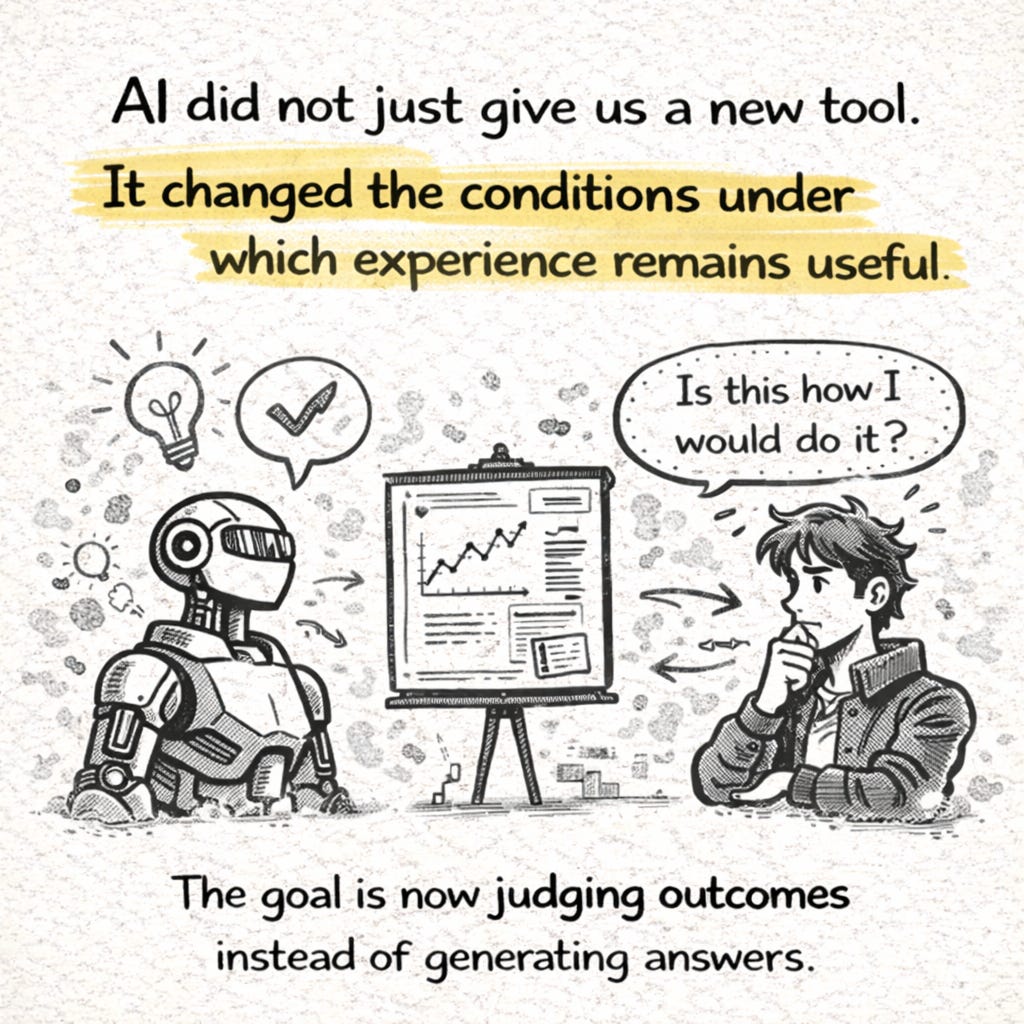
AI did not just give us a new tool.
It changed the conditions under which experience remains useful.
For the first time, we are consistently working with systems that generate viable solutions faster than we can reason through them, operate beyond our intuitive understanding, and are not constrained by the same mental models that trained us.
And yet our reaction is still deeply human.
We look at the output and ask: is this how I would do it?
That used to be a reasonable proxy for quality.
It is not anymore.
The question is no longer whether the solution matches our reasoning. The question is whether it works in the context that matters. In other words, our work is shifting from producing the answer to judging the answer. In many ways, engineering has already been drifting in that direction as coordination, trade-offs, and decision-making under ambiguity take more weight than pure execution.
That is a much bigger change than most engineers want to admit.
Because AI is not just challenging how we build. It is challenging the identity we built around being the person who knows.
In a probabilistic world, experience does not disappear. But it loses its status as final authority. It becomes one input among others.
And very often, it becomes bias.
We Are Not Competing With the Machine
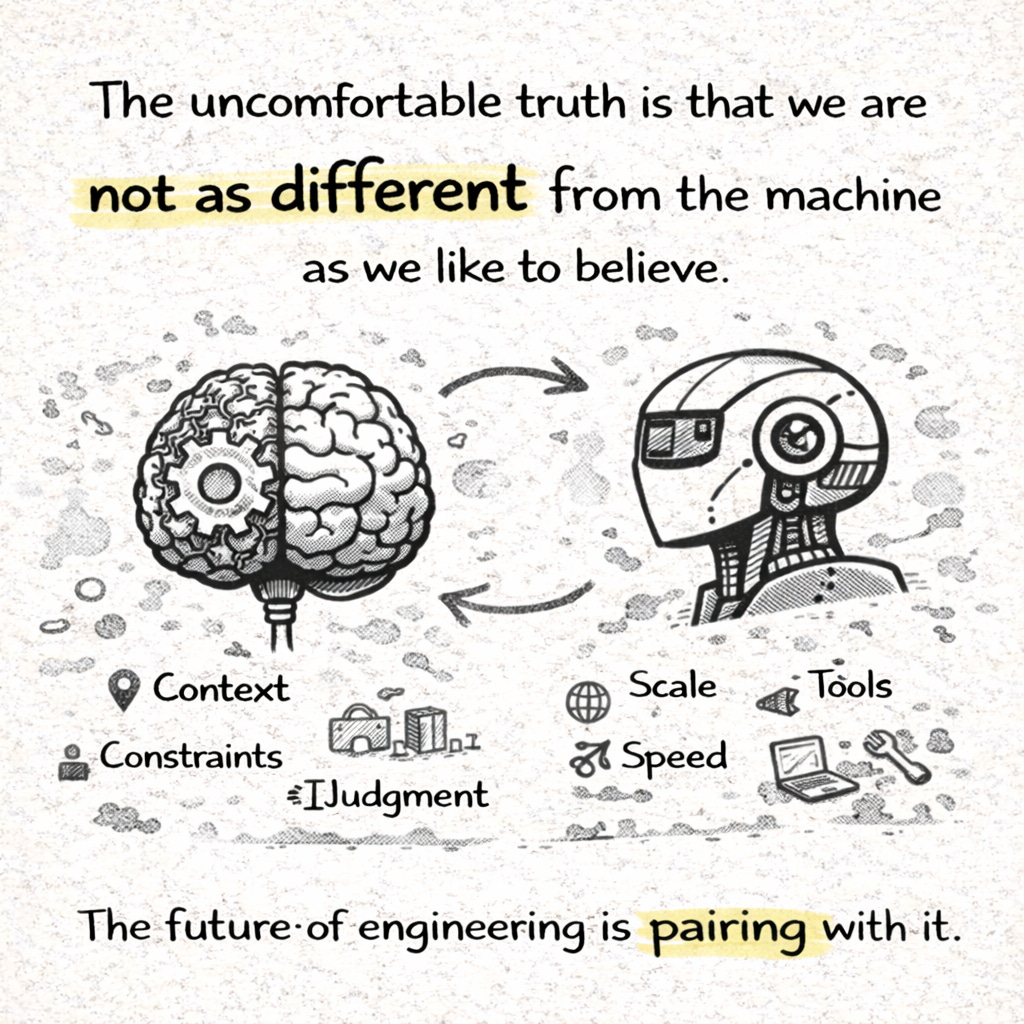
The uncomfortable truth is that we are not as different from the machine as we like to believe.
Our brains are also trained systems. They learn from data, reinforce patterns, and reuse what has worked before. The difference is not that one of us learns and the other does not.
The difference is scale, speed, tools and attachment.
The machine has broader exposure, faster iteration, and no ego attached to its last answer. We have context, judgment, and an understanding of constraints the machine still lacks. These are not competing strengths. They are complementary ones.
That is why the future of engineering is not about beating the machine. It is about pairing with it.
The leverage is not in proving we are smarter. It is in knowing where we are stronger. The machine is better at exploring, generating, and iterating without hesitation. We are better at framing the problem, understanding the environment, and judging what matters.
The teams that win will be the ones that stop treating AI like a rival and start treating it like a second brain. Not a replacement for judgment, but an amplifier of it. Not a source of truth, but a system that expands the range of what we can test, challenge, and validate.
That is the adaptation.
Not surrender.
Not blind trust.
Just a more honest understanding of where our value now lives.
Final Thought
The hardest part of AI is not the technology.
It is changing our mental model and letting go of the identity we built around being the one who knows.
For years, the industry struggled with the ego of senior engineers dismissing juniors.
Now all of us are that senior engineer.
And the thing we are dismissing is not a junior. It is a machine that, in many cases, explores faster than we do, generates more than we do, and reaches viable answers before we do.
The question is not whether engineers still matter.
We do.
The question is whether we can let go of our ego long enough to work with something that keeps forcing us to admit that being experienced is no longer the same thing as being right.