

The Moment Process Starts Eating Your Day
How governance expansion displaces value and strategic work in engineering leadership

Introduction
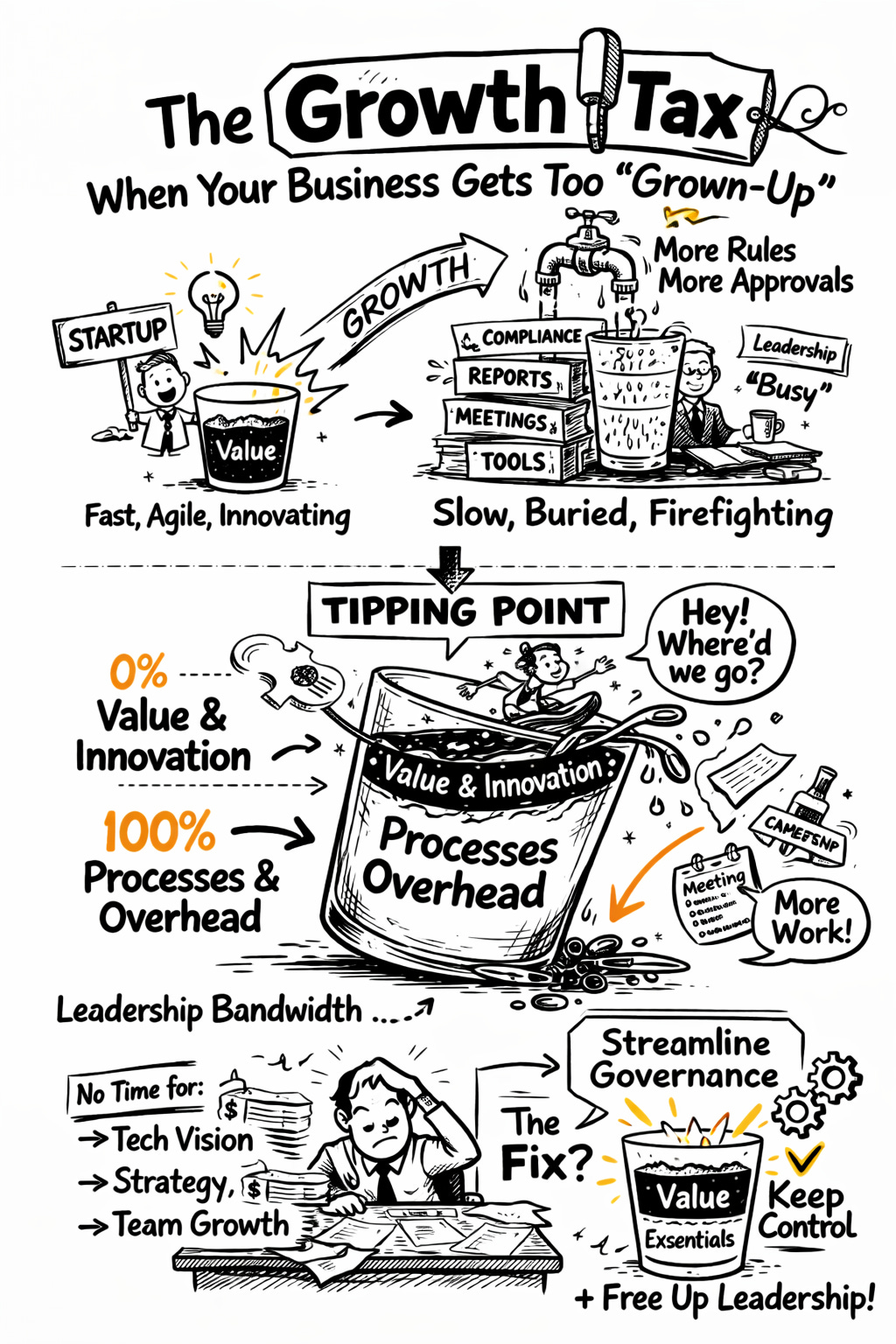
As organizations scale, governance expands. Reporting structures multiply, compliance requirements mature, alignment rituals increase, and cross-functional touchpoints become more frequent. None of this is inherently problematic. In fact, process often emerges to reduce chaos and increase predictability.
However, there is a tipping point.
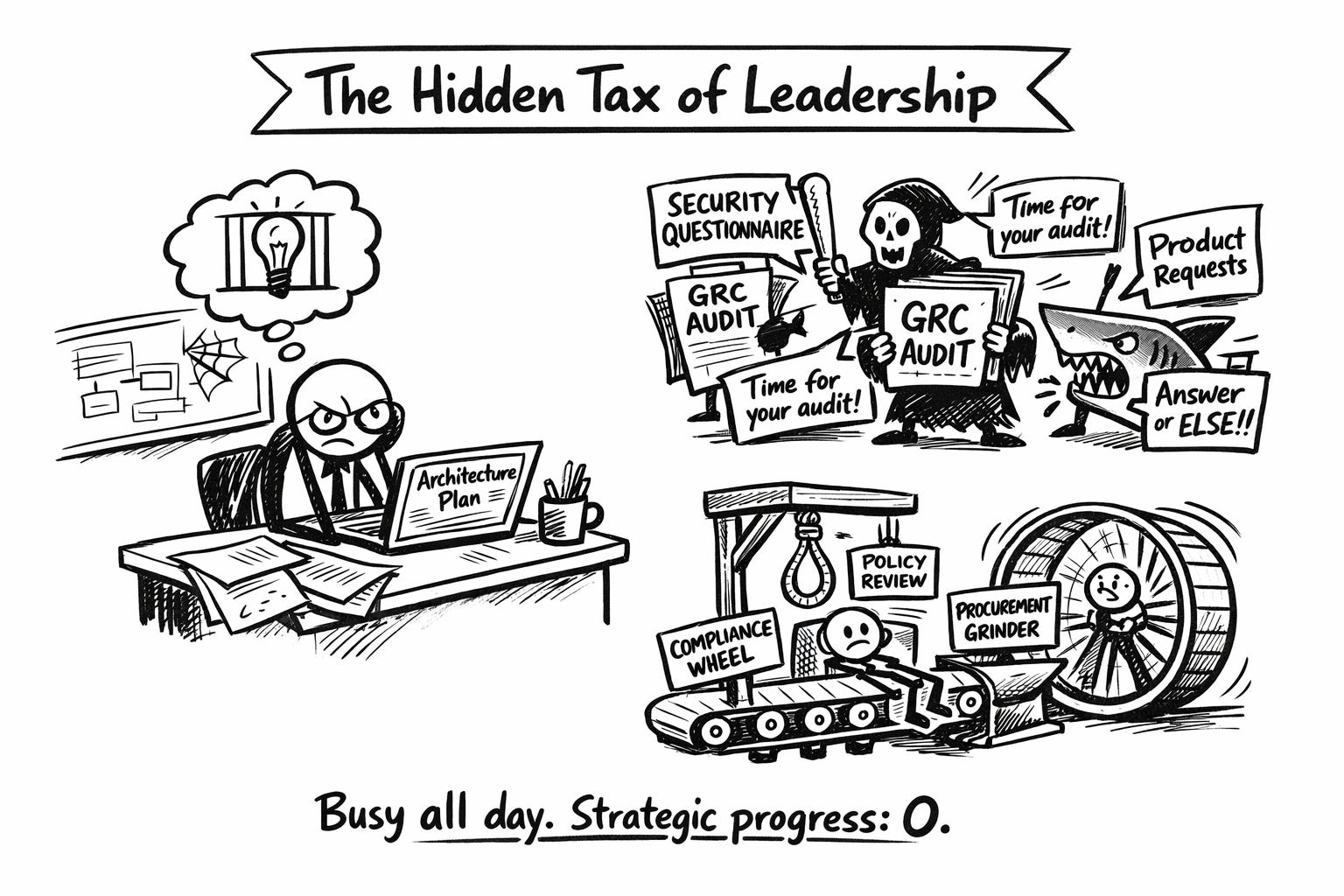
At a certain stage of organizational growth, engineering leaders begin to notice a structural shift: the majority of their time is no longer invested in enabling value creation or shaping long-term direction. Instead, it is absorbed by coordination, documentation, reporting, and operational synchronization.
This is the moment the process starts eating the day. The risk is not that the process exists. The risk is when the process begins to systematically displace strategic and value-generating work.
The paradox is clear: process is introduced to support value creation, yet beyond a certain threshold, it competes with it.
Governance in Growing Environment Normally Becomes Self-Reinforcing
As organizations grow, process layers are often added in response to past incidents or perceived risk. Rarely are they removed. Over time, leaders inherit overlapping rituals, redundant reporting, and duplicated reviews.
Research on digital transformation from McKinsey indicates that complexity is a primary cause of execution failure in scaling organizations. High-performing digital companies actively simplify decision-making and reduce unnecessary procedural friction.
When process expansion is not accompanied by intentional simplification, it gradually dominates leadership bandwidth as governance complexity compounds over time.
Engineering leaders become coordinators of governance rather than designers of systems.
Value Work vs. Process Work
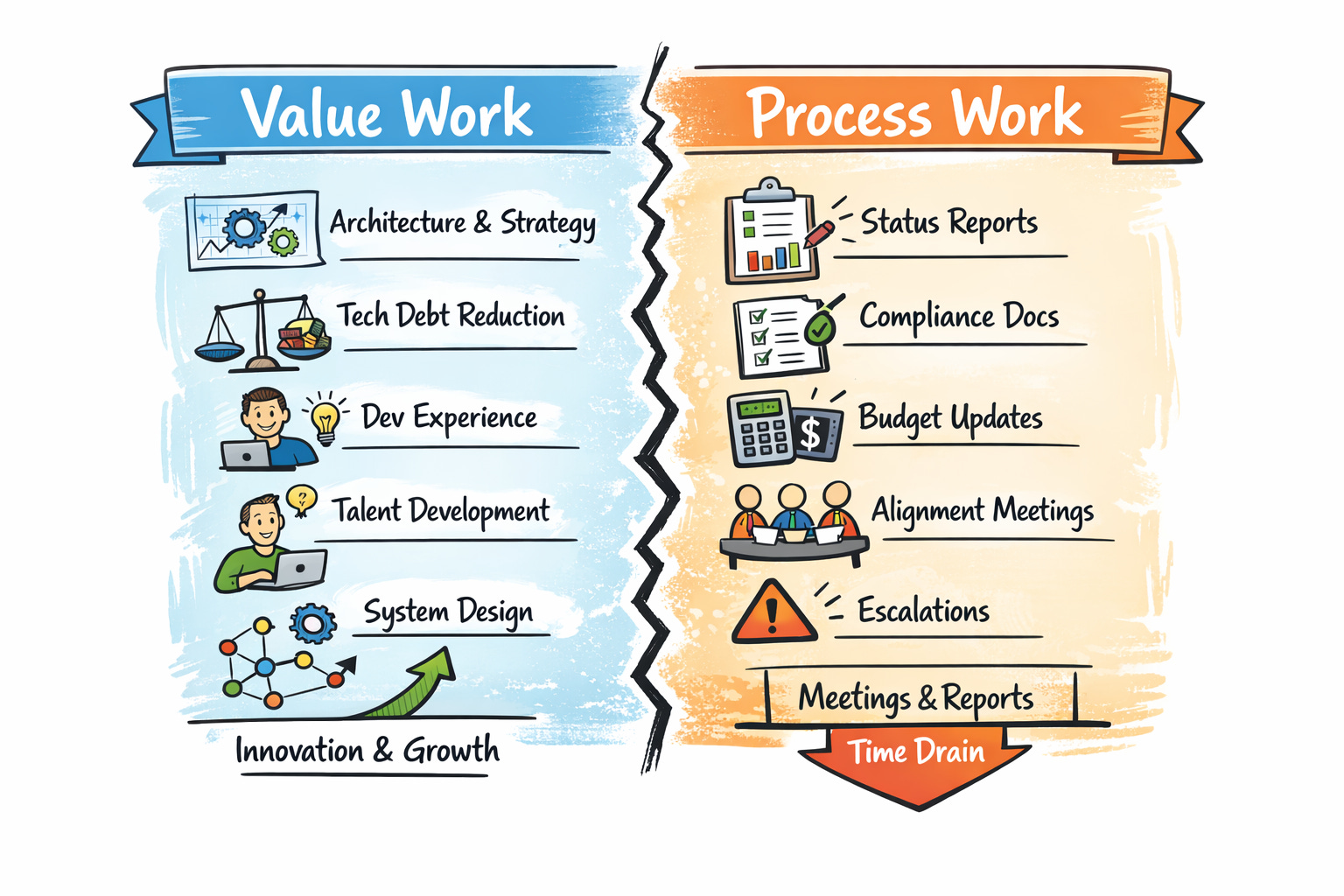
To understand the tipping point, it is useful to distinguish between two categories of leadership effort:
Value-oriented work includes:
Architectural & strategic direction setting
Technical & non-technical prioritization
Developer experience improvement
Talent development and mentoring
Long-term system design
Process-oriented work includes:
Status reporting
Governance documentation
Compliance questionnaires
Budget control & updates
Recurrent alignment meetings
Escalation handling
Both categories are necessary. However, only one category compounds long-term engineering capability.
Beyond the time allocation, there is also a cognitive dimension to this problem. As value-oriented tasks require uninterrupted cognitive bandwidth. When leadership calendars are saturated with 30-minute blocks dedicated to reporting, coordination, and alignment, deep thinking becomes fragmented.
The result is not immediate failure, but a slow erosion of strategic clarity:
Architectural decisions become reactive.
Technical debt accumulates incrementally.
Innovation slows.
Platform investments are deferred.
The organization continues operating, but its engineering foundation weakens. In engineering leadership, process overload does not merely consume time; it reduces strategic depth.
The Strategic Opportunity Cost
The most significant cost of process saturation is opportunity cost.
Time invested in incremental reporting is time not invested in:
Platform modernization
Reliability engineering
Developer productivity tooling
Technical innovation
Architectural resilience
These investments may not generate immediate visibility, but they determine long-term competitiveness.
DORA research demonstrates that elite-performing engineering organizations achieve both higher velocity and stronger stability. This dual capability is not accidental; it results from consistent investment in foundational engineering practices.
If leadership capacity is absorbed entirely by governance management, the organization risks optimizing for short-term coordination while sacrificing long-term capability.
Restoring Balance: Designing for Strategic Capacity
The solution is not eliminating the process. Governance is necessary in complex systems. The objective is balance.
Periodic process audits are important. Every recurring meeting and reporting requirement should be evaluated against a simple question: does this materially improve decision quality or reduce meaningful risk?
If not, it should be simplified or removed.
Protecting strategic bandwidth is not optional. It is a prerequisite for sustainable engineering performance.
Conclusion
The moment the process work starts eating the day is rarely dramatic. It is incremental. A few more meetings. Additional reporting cycles. Expanded review layers. Increased cross-functional synchronization.
Over time, the cumulative effect is substantial.
Engineering leadership requires governance, but it also requires protected space for value creation and strategic direction.
When process displaces strategy, long-term engineering capability erodes.
The responsibility of engineering leadership is not to resist governance but to prevent it from overwhelming the system it was designed to support.
Sustainable organizations do not eliminate process. They design it intentionally and defend the time required to build the future.